
Two containers can leave the port of Nhava Sheva on the same vessel, bound for Jebel Ali. One belongs to a business you won yourself, where you chose the route and the destination agent. The other is business someone else won—usually the buyer's forwarder—who sent you a routing order to execute. The first is freehand cargo; the second is nominated. Knowing the difference is critical, because the customer, the sales motion, and the risks are not the same. For the wider picture, see the complete guide to agent performance.
The short answer
The difference between freehand and nominated cargo comes down to who controls the routing. Freehand cargo is business you won yourself, where you choose the routing and the overseas agent. Nominated cargo is business routed by someone else, usually the buyer's forwarder, who sends a routing order telling your team at origin what to do.
For a forwarder, the distinction is fundamental. On a freehand shipment, the shipper is your customer, and you own the relationship. You sell the solution. On a nominated shipment, the overseas agent or their customer is your principal; you sell execution and reliability. Your network is your fleet, and it should be run on evidence of which partners deliver, whether the cargo is freehand or nominated.
What freehand cargo means
A free hand shipment is cargo where your company sourced the business and controls the transport plan. It’s the classic model of freight forwarding: a shipper or consignee asks you for a quote, you win the business, and you design the solution.
You Own the Customer Relationship
With freehand cargo, the shipper is your direct customer. You quoted them, you manage their expectations, and you are accountable for the end-to-end service. The freehand shipment meaning is rooted in this direct commercial control. You are not just an executing party at origin; you are the architect of the move.
You Control the Routing and Partner Selection
Because you own the relationship, you typically choose the key components of the shipment:
- The carrier or airline: You select the shipping line, NVOCC, co-loader, or airline that best fits the customer's needs for price, transit time, and reliability.
- The routing: You decide the port pairs, transshipment points, and service level, whether it’s a direct sailing from Mundra to Felixstowe or a consolidated air shipment to Los Angeles/Long Beach.
- The overseas agent: You appoint your trusted partner at the destination to handle arrival, clearance, and final delivery.
This control is why many forwarders prefer freehand business. It allows you to use your expertise, leverage your carrier relationships, and work with agents you know and trust.
What nominated cargo means
A nominated shipment is one where an external party—typically the buyer, the consignee, or their own freight forwarder—dictates who handles the freight. Your role as the origin agent is to execute a plan that has largely been decided for you. The nominated shipment meaning is that you are appointed, or "nominated," to perform a specific set of tasks.
The Controlling Party Appoints the Forwarder
On nominated cargo, your customer is not the local shipper. Your customer is the overseas agent or principal who sent you the business. The local shipper is a party you coordinate with, but they do not control the main carriage decision. This is a crucial distinction, as many freight partner terms explained in the industry hinge on who holds commercial control.
Why FOB Often Leads to Nominated Cargo
The choice of Incoterms® 2020 rule is a major factor. Under FOB (Free On Board), the commercial reality often results in a nominated shipment. According to the ICC Academy, with FOB the seller delivers the goods on board the vessel nominated by the buyer at the named port of shipment, and the buyer arranges the main contract of carriage.
Because the buyer controls the main freight, the buyer’s forwarder usually controls the move. That forwarder then nominates an agent in the origin country to handle the export formalities and get the cargo to the port. So, on an FOB sale from Chennai to the UK, the UK buyer's forwarder will likely send a routing order to its partner agent in India. That Indian agent is handling a nominated shipment.
The Origin Agent as an Executor
Your job on a nominated file is to execute flawlessly. The nominating partner chose you for your local expertise and reliability. You are their eyes and ears on the ground, ensuring the cargo is collected, documented correctly, and handed over to the designated carrier on time.
What a routing order is
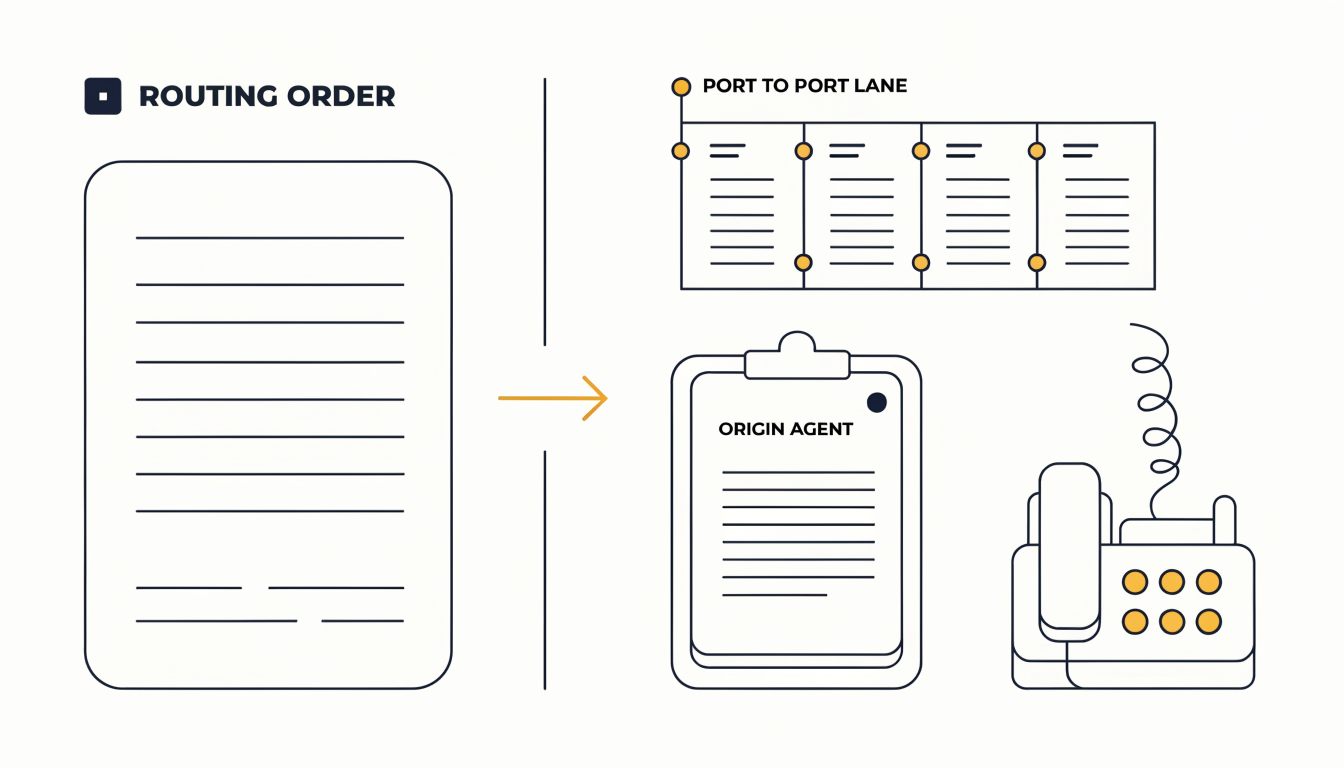
A routing order is the key instruction in a nominated shipment. It is the document or message the controlling forwarder sends to its agent at origin, detailing exactly what needs to be done. It’s not a request for a quote; it’s a work order. The origin agent’s job is to carry out someone else's plan.
Core Components of a Routing Instruction
A clear routing order removes ambiguity. It should specify who, what, where, when, and how. A weak instruction creates risk and delays. A strong one provides a clear checklist for your operations team.
Sample Routing Order
A practical routing order, whether in an email or a TMS, should contain these fields:
Routing Order – Ref: [Booking Reference]
- Shipper: [Shipper Name, Address, Contact]
- Consignee: [Consignee Name, Address]
- Nominating Party: [Name of Overseas Agent/Principal]
- Incoterm & Place: [e.g., FOB Nhava Sheva, Incoterms® 2020]
- Cargo Details: [Commodity, Pcs, Weight, Dims, Container Type]
- Nominated Carrier: [Carrier Name, Service, Booking #]
- Cargo Cut-Off: [Date and Time]
- Documentation Cut-Off: [Date and Time]
- Documents Required: [Commercial Invoice, Packing List, Shipping Instructions, etc.]
- Special Instructions: [e.g., "Bill of Lading to show freight collect"]
As the origin agent, your team’s responsibility is to execute these instructions precisely. Any deviation, such as a change in carrier or a missed cut-off, must be communicated back to the nominating party for approval.
Freehand vs nominated, side by side
Understanding the difference between freehand vs nominated cargo helps you define your sales strategy, manage operational risk, and evaluate your agent relationships. Here is a direct comparison.
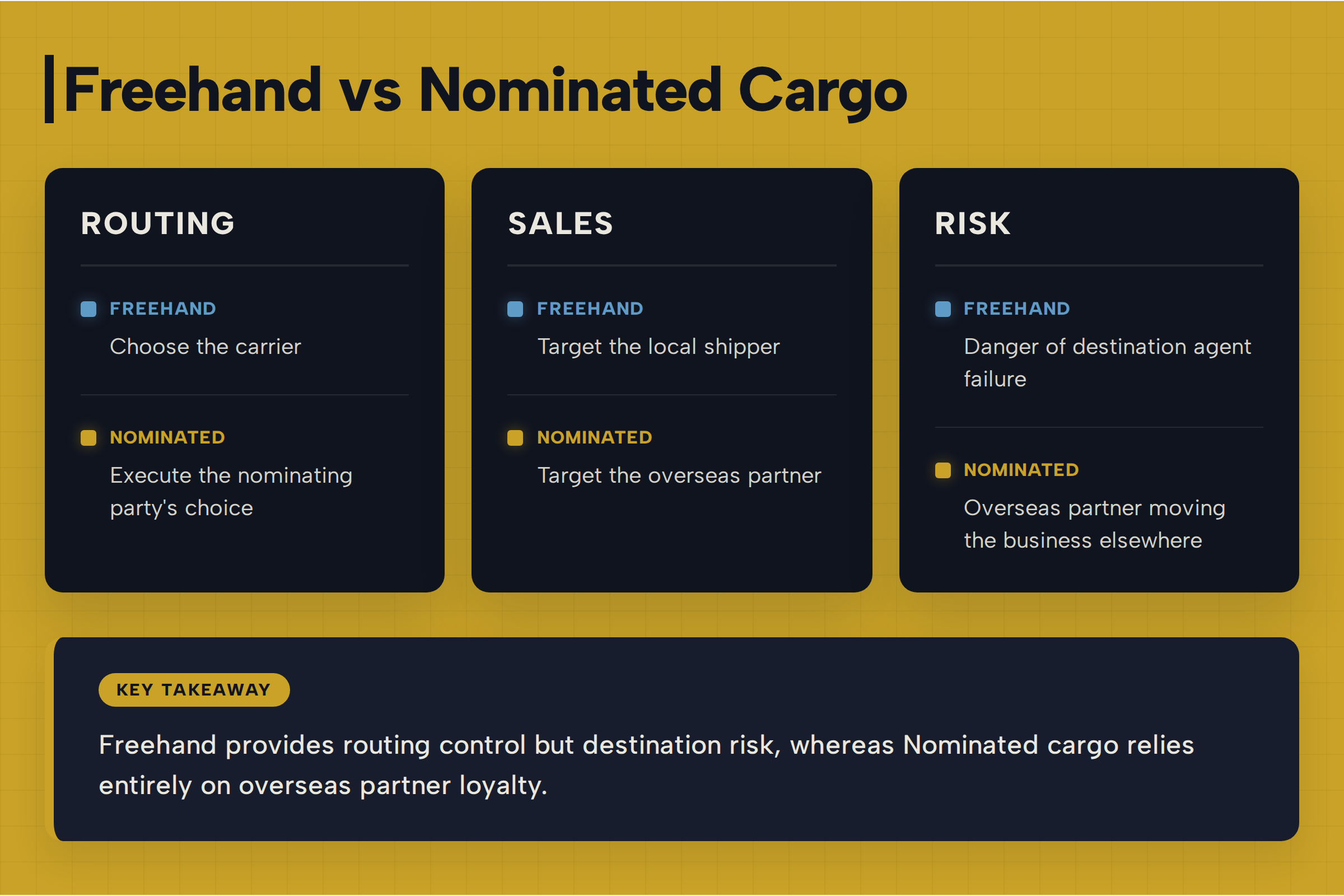
| Question | Freehand Cargo | Nominated Cargo |
|---|---|---|
| Who is your customer? | The local shipper or exporter who asked you to arrange the shipment. | The overseas buyer, consignee, or their forwarder who appointed you. |
| Who chooses the carrier and routing? | You do, based on your expertise and the shipper's requirements. | The nominating party. You execute their choice. |
| Who do you sell to? | The local shipper. You sell a complete transport solution. | The overseas partner. You sell reliable origin execution. |
| How do you win more of it? | Direct sales to shippers, based on competitive pricing, service, and relationships. | Building a reputation for flawless execution and clean settlement with overseas agents. |
| What is the main risk? | Your chosen destination agent fails, damaging your customer relationship and potentially holding cargo hostage over settlement. | Your revenue depends on an overseas partner who can move the business to another agent at any time. |
Risks on each side
Both freehand and nominated cargo come with distinct risks. A forwarder that runs both needs to manage them differently.
Risks in Freehand Shipments
On a free hand shipment, you choose the destination agent. This gives you control, but also responsibility. The biggest risk is that the agent you picked holds your customer's cargo. If there's a dispute over settlement or unexpected destination charges, that agent has significant leverage. A bad agent can destroy a good customer relationship overnight.
This is why it's crucial to know how to vet an overseas agent before you send them your first shipment. Check their settlement behavior, their communication standards, and their process for handling disputes. Your network is your fleet; don't let a weak link sink a shipment.
Risks in Nominated Shipments
With nominated cargo, the risk shifts from execution to dependency. Your revenue stream for that business is entirely dependent on the goodwill of the overseas partner who sends you the routing orders. They can, and sometimes do, move their business to a different origin agent for a lower handling fee or as part of a network-wide deal.
You have less control over the overall profitability and longevity of the business. Your best defense is to be so reliable and easy to work with that the nominating partner has no reason to look elsewhere.
How to win and keep nominations
Winning more nominated business is not about sales pitches. It’s about operational excellence. The nominating forwarder, your true customer, chooses an origin agent based on three simple criteria: reply speed, flawless execution, and clean settlement.
Measure What Matters
Don't rely on impressions from an annual network meeting. Keep your own data. The nominating forwarder wants an agent who makes their life easier. Track your performance on:
- Response Time: How quickly do you acknowledge a routing order and confirm a booking?
- Execution Quality: What is your rate of on-time pickup, correct documentation, and on-time delivery to the carrier?
- Settlement Discipline: Are your invoices accurate? Do they match the quote? Are there surprise charges?
Keeping your own record of these numbers per partner is the foundation of a strong agent relationship. You can see how different agent scorecards compared can reveal your strongest and weakest partners.
Turn Freehand into Nominations with Reciprocity
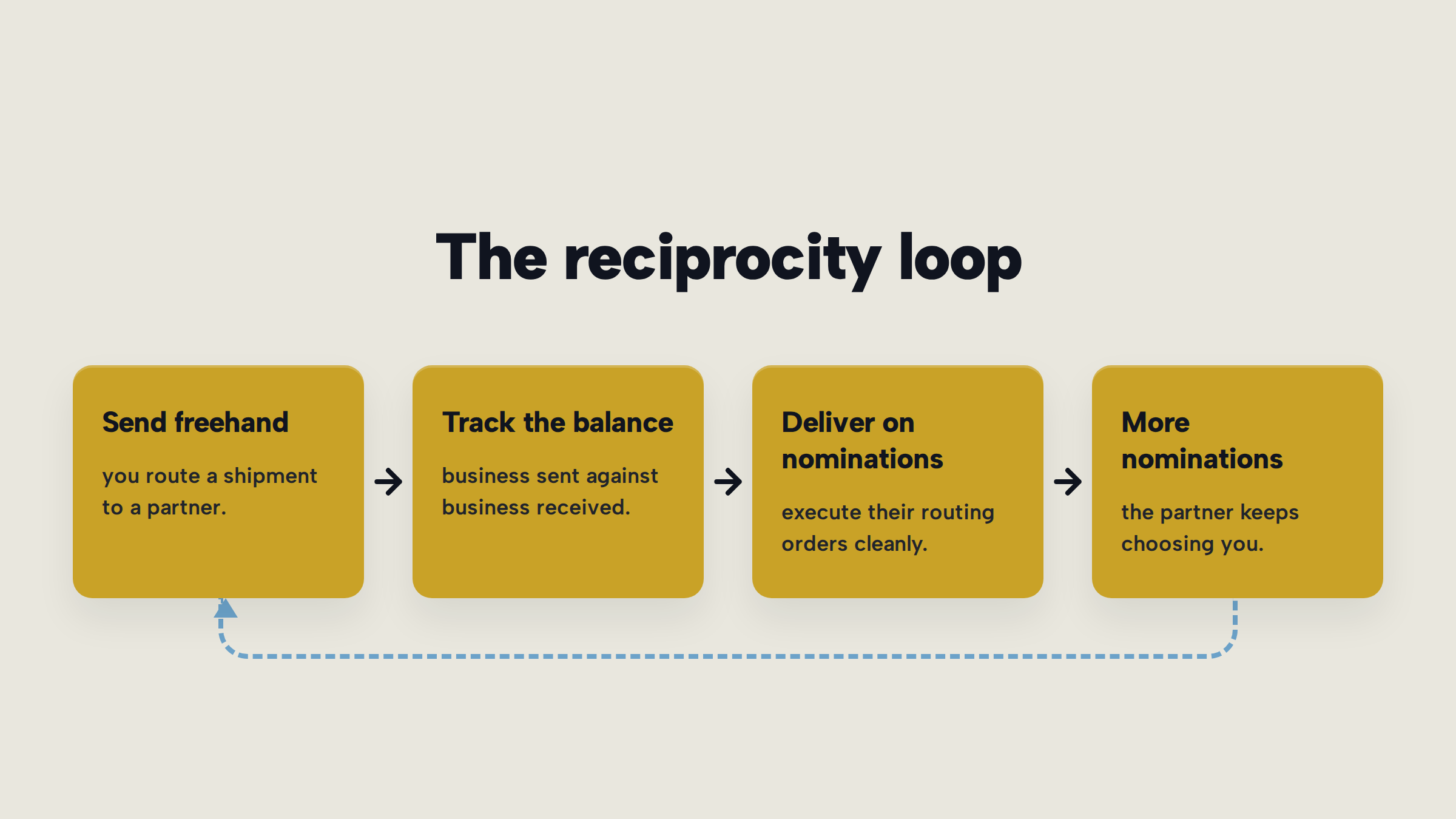
The most powerful tool for growing nominated business is reciprocity. Send your freehand cargo to partners who send you nominations. This creates a virtuous cycle. But you can't manage what you don't measure. Keep a clear, data-driven account of the business you send and receive with each partner. This is the reciprocity ledger.
When you can show a partner the exact volume and value of the business you've sent them, the conversation about them sending you more nominations becomes much more productive. Winning freehand cargo from shippers is a separate sales motion, built on your own rates and service.
Where VendorFinder AI fits
This is where managing the freehand vs nominated dynamic moves from spreadsheets and email to a systematic process. VendorFinder AI, built on the FreighAI platform, is designed to run your network on evidence.
For your freehand cargo, VendorFinder AI scores your agents and partners from your own shipment history, so a lane goes to the partner who has actually performed on it. Instead of relying on memory or a conference handshake, your team can see which agent has actually performed on the specific lane, whether it's Mundra-Felixstowe or Chennai-Los Angeles.
For managing both freehand and nominated business, VendorFinder AI keeps count of the business you send a partner against the business they send you. This reciprocity ledger gives you a factual basis for partner reviews. You can see which relationships are balanced and which are one-sided, allowing you to allocate your valuable freehand shipments to partners who help you grow. See how the desk works to understand the mechanism.
Ready to run your agent network on evidence, not impressions? It's time to rank a lane live and see which of your partners truly performs.
Frequently Asked Questions
What is a free hand shipment?
A free hand shipment (also called a freehand shipment) is cargo where the freight forwarder has been chosen directly by the shipper or exporter. In this model, the forwarder controls the shipment, meaning they choose the carrier, the routing, and the overseas agent at the destination. The customer relationship is with the shipper, and the forwarder sells a complete transport solution.
What is a nominated shipment in export?
A nominated shipment in export is cargo where the buyer or consignee (or their overseas forwarder) has chosen—or "nominated"—the freight forwarder or carrier. The origin agent receives a routing order with instructions to follow. The origin agent's customer is the overseas nominating party, not the local shipper, and their role is to execute the pre-defined plan.
What is a routing order in shipping?
A routing order is the set of instructions sent by the controlling party (usually the buyer's forwarder) to the origin agent in a nominated shipment. It specifies key details like the shipper and consignee, the nominated carrier and service, cargo and documentation cut-off dates, and what documents are required. It is essentially a work order for the origin agent to execute.
Is FOB cargo always nominated?
FOB (Free On Board) cargo is very often handled as a nominated shipment, but not always. Under the Incoterms® 2020 rule for FOB, the buyer is responsible for arranging and paying for the main carriage. According to the ICC Academy, this means the buyer nominates the vessel. Consequently, the buyer's forwarder typically controls the shipment and nominates the origin agent. However, the exact arrangement can be modified by the sales contract, so while FOB strongly implies nomination, it's the specific instruction from the buyer that confirms it.
How do I win more nominated cargo?
Winning more nominated cargo depends on your reputation with overseas agents and principals. They prioritize reliability, communication, and ease of doing business. To win more, focus on operational excellence: respond to routing orders quickly, execute shipments without errors, provide accurate and timely documentation, and ensure your invoicing is clean and matches the agreed rates. Tracking your performance with an agent scorecard and practicing reciprocity—sending your freehand business to partners who nominate you—are key strategies.
Sources & References
This article draws on research and data from the following verified sources:
From reading to running.
Everything above runs live in a working partner desk. Bring one lane you don't serve yet and watch the shortlist, the RFQs and the comparison happen.
Book the working sessionKEEP READING