
Before you trust a new overseas agent with your first shipment, run six checks: payment protection and credit exposure, financial standing, tenure and references, licences and accreditations, local capability, and measured responsiveness. This is the bedrock of effective freight partner vetting. Write the answers down. You will need them at renewal, and you will definitely need them if something goes wrong. This isn't just paperwork; it's the evidence that separates a reliable partner from a liability. For a deeper dive, see the complete guide to finding overseas agents.
Why a network badge is not enough
A handshake at a conference and a logo on a website feel reassuring. But they are not enough. Your network is your fleet, and it should be run on evidence, not impressions. The difference between the two is what protects your cargo, your cash, and your reputation.
Membership is a point-in-time check
Membership in a freight forwarder network means a vetting process happened once, at admission. It was a snapshot, not a continuous audit. The agent was vetted then, not for your specific lane next month. The financial health, operational staff, and ownership of that company could all have changed since they paid their membership fee. Relying on that badge alone is a bet, not a strategy. The real work of freight partner vetting is the work you do yourself.
The risks that hurt are operational and financial
When an overseas partnership fails, the consequences are severe and immediate. These are the risks that keep operations managers awake at night:
- The agent cannot pay. If they fail to pay the carrier, terminal, or customs, your cargo can be held hostage, even if your client has paid you in full.
- Cargo is held over a dispute. A disagreement over destination charges, demurrage, or documentation can lead to a lien on your cargo until someone pays. - Double payment. When settlement processes are loose—relying on email and memory—it’s easy to pay the same charge twice, once as an advance and again on the final invoice.
- Radio silence. The agent who was so responsive during the sales process goes quiet the moment a shipment has a problem at customs in Nhava Sheva or is stuck at the Port of Los Angeles.
This is why you need a system based on evidence compared with conference networking. Network payment schemes can offer a backstop, but they are not a substitute for your own due diligence. To understand their limits, it helps to know how network protection programmes work.
The six checks for freight forwarder due diligence
A robust freight partner vetting process rests on six distinct checks. Run them before the first shipment, and document the results. This creates an auditable file that protects your business and makes renewal decisions objective.
1. Payment protection and credit exposure
First, understand your financial risk. If the agent is in a network with a payment-protection programme, confirm the cap and what it covers. Does it apply per claimant or per incident? Is your likely exposure—unpaid invoices plus cargo in transit—well under that cap? Either way, set your own credit limit. For a new partner, this might be one shipment at a time, with no unsecured exposure until a payment history is established.
2. Financial standing
Ask for a recent credit report from a recognized agency. Where possible, request the last two years of accounts. A refusal to share any financial information is a major red flag. Critically, verify how long the agent has traded under its current legal name. A company that frequently changes its name or structure may be hiding a history of debt or disputes.
3. Tenure and references
How long has the agent been in business? More importantly, how long have they served the specific lane you need? Ask for two references from other forwarders who use them on that same lane—and then actually call them. Ask the reference about communication, invoice accuracy, and how the agent handled a problem shipment. A reference from a different trade lane is not relevant evidence.
4. Licences and accreditations
Verify credentials with the issuing body. For US ocean trades, check the agent against the Federal Maritime Commission (FMC) list of licensed and bonded ocean transportation intermediaries. According to the FMC, a US-based ocean freight forwarder must show financial responsibility of $50,000 and a US-based NVOCC $75,000; an unlicensed NVOCC registered from outside the US needs $150,000. For air freight, ask for their IATA cargo agent accreditation. According to IATA, this accreditation signals to airlines that the agency is financially sound and professionally trained. Don’t just accept a logo on an email signature; confirm it with the issuing body.
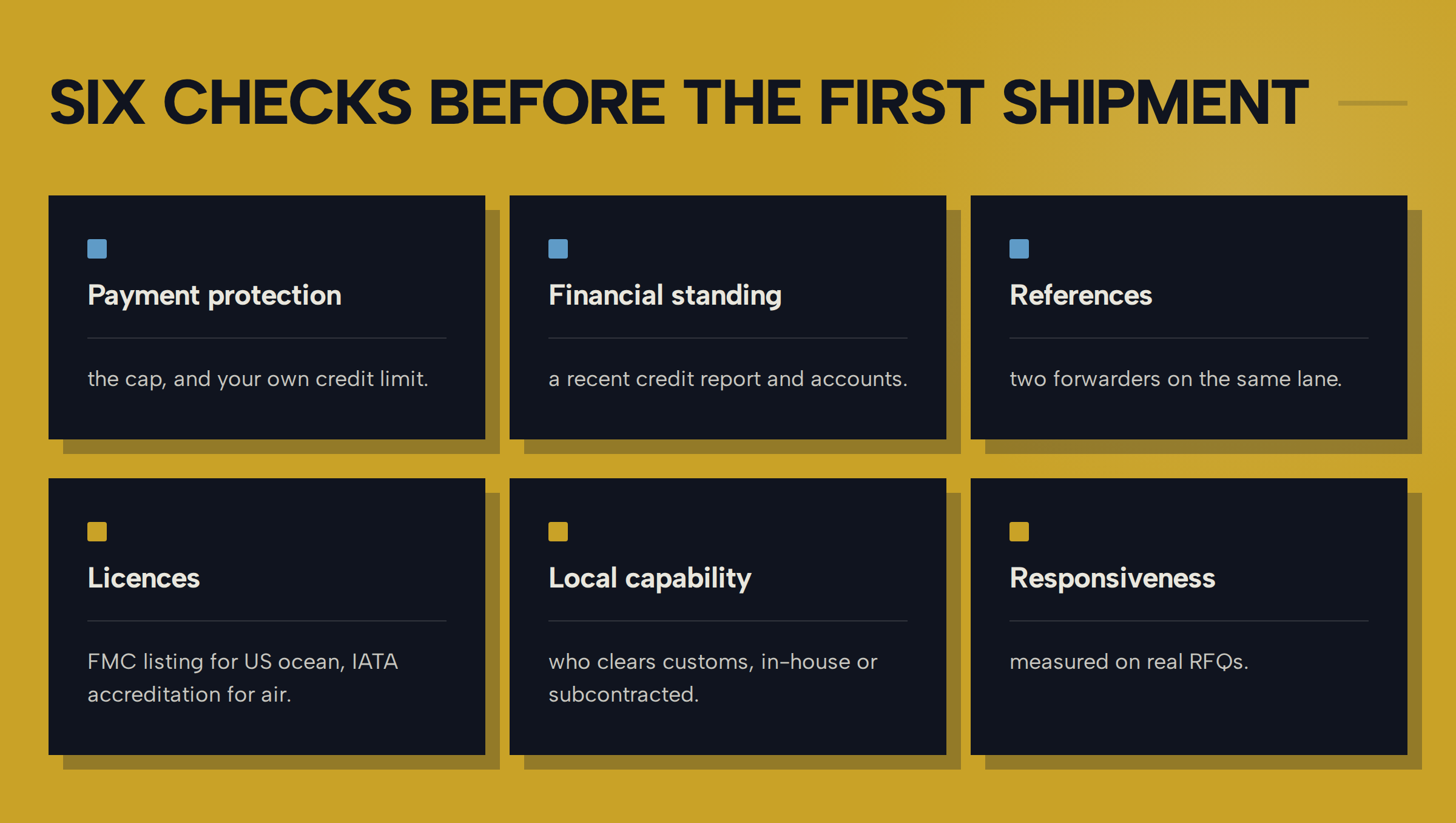
5. Local capability
An office in Mumbai does not guarantee capability at Mundra. Ask who clears customs at the destination port: is it an in-house team or a subcontractor? Do they own their warehouse and trucks, or buy in capacity? What specific commodities do they handle regularly? If you ship pharmaceuticals, an agent who primarily handles general cargo is not a good fit, no matter how cheap their quote is.
6. Measured responsiveness
This is the one check that never ends. Before you award any business, test them with a real partner RFQ. How quickly and, more importantly, how completely do they answer? A fast but incomplete quote that misses key surcharges is a warning sign. Measure their responsiveness on every single request. This is the truest indicator of the service you will receive when your cargo is on the line.
Questions to ask out loud
During your vetting interview, vague assurances are worthless. You need specific answers to direct questions. Here are five to start with:

- Which payment-protection programme covers you, and at what cap? A credible agent knows the name of their network's programme and the exact USD value of the cap. If they don't, the protection is likely irrelevant.
- Who clears customs at your end, and on which commodities? You want to hear a company name and a list of commodities they are confident with. "We handle everything" is not an answer.
- Which two forwarders on this lane will speak to me about you? The key phrase is "on this lane." A reference for a different trade is not a reference for your business.
- What quote turnaround will you commit to on this lane? Get a specific number of hours and clarify if that's for a firm quote or just an acknowledgement.
- What settlement terms and currency do you work in? Nail this down from day one. Surprises in settlement can destroy the margin on a shipment.
The freight partner vetting checklist (free template)
Keep this checklist on file for every agent. Update it at renewal or if performance slips. This simple discipline turns subjective feelings into objective evidence, forming the core of your freight partner vetting process.
| Check | Question to Ask | Evidence to Collect | Red Flag |
|---|---|---|---|
| 1. Payment & Credit | Are you covered by a payment-protection programme, and what is the cap? What are your standard credit terms? | Written confirmation of network protection cap; agreed credit limit in writing. | Vague answers on protection; refusal to agree to a starting credit limit. |
| 2. Financial Standing | Can you provide a recent credit report or your latest available financial accounts? | Independent credit report (less than 6 months old); copy of filed accounts. | Refusal to provide any financial data; a history of name changes. |
| 3. Tenure & References | Which two forwarders using you on this lane will act as a reference? | Names, contact details, and notes from calls with two independent, lane-specific forwarder references. | References are from different trade lanes, are suppliers, or are uncontactable. |
| 4. Licences & Accreditations | What is your FMC OTI number (for US ocean) or IATA cargo agent code (for air)? | FMC listing showing active status; for air, accreditation confirmed with IATA or the airline. | Expired licence; name on licence does not match invoicing entity. |
| 5. Local Capability | Who handles customs at the destination port? Is your warehouse and trucking owned or subcontracted? | Written confirmation of customs broker; details of key subcontractors. | Unwillingness to name subcontractors; claims to be an expert in all commodities. |
| 6. Responsiveness | What is your committed response time for a complete RFQ on this lane? | Timed results from at least two test RFQs; a written SLA for quote turnaround. | Slow or incomplete replies to test RFQs; no commitment to a service level. |
What only your own data can tell you
After the first shipment, the most important evidence is generated by you. No public standard or network certification can tell you how an agent actually performs on your lanes. The only way to know is to measure it.
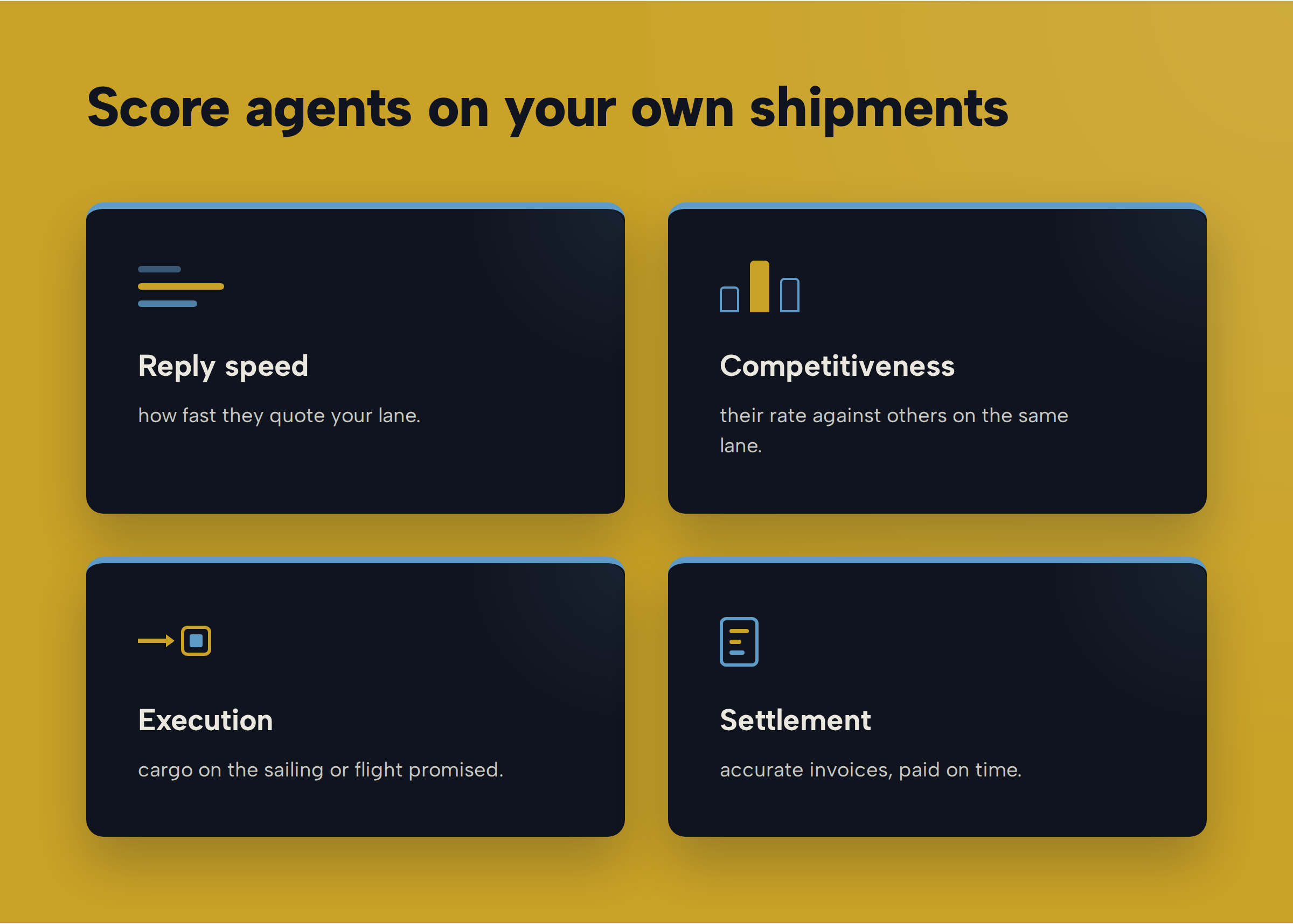
Build your own agent scorecard
Effective freight partner vetting doesn't stop after the initial checks. It becomes a continuous process of performance management. Track every shipment and measure your partners on what matters:
- Reply Speed: How long does it take them to quote a lane?
- Quote Competitiveness: How do their rates compare to others on the same lane?
- Execution: Do they get your cargo on the vessel or flight they promised?
- Settlement: Are their invoices accurate and timely? Do they pay on time?
There is no universal score for these relationships; you have to build it from your own shipment history. For a structured approach, see these agent scorecards compared.
Track the reciprocity
A healthy partnership is a two-way street. It's crucial to track the business you send to each partner against the business they send back to you. An agent who executes your import shipments flawlessly but never sends you a single export nomination is a good supplier, but not a true partner. Maintaining the reciprocity ledger provides the commercial context for your operational scores, ensuring your most valuable partners get your best business.
Where VendorFinder AI fits
This is where software can work alongside your team. Manual freight partner vetting is essential for initial qualification, but tracking performance across dozens of partners and hundreds of shipments is hard to keep up with spreadsheets and email alone.
VendorFinder AI, built on FreighAI, works from your data. It scores your agents and partners from your own shipment history, so a lane goes to the partner who has actually performed on it. It also keeps count of the business you send a partner against the business they send you, making reciprocity visible at a glance.
When you need to find a new agent or benchmark existing ones, Partner Discovery picks the right agents for a lane, prepares and sends the RFQ email to each, tracks the replies, and lines up the rates side by side on one page. It brings structure and evidence to the partner selection process. To see more, you can explore how the desk works.
This is a workflow and partner-history tool. It does not replace your legal, financial, or compliance due diligence. The handshake and the homework both belong to you.
Ready to move beyond spreadsheets? Let us show you how to score your partners on your own data. You can rank a lane live with our team.
Frequently Asked Questions
What is an IATA cargo agent?
An IATA cargo agent is a freight forwarder or agency that has been accredited under the International Air Transport Association's (IATA) Cargo Agency Program. According to IATA, this accreditation is intended as a signal to airlines that the agency is financially sound, professionally competent, and has staff trained in handling air cargo. It is a valuable credential but should be confirmed with IATA or the airline and supplemented with your own due diligence.
How do I check a US ocean intermediary?
To verify a freight forwarder or NVOCC (Non-Vessel Operating Common Carrier) operating in United States ocean trades, use the Federal Maritime Commission’s (FMC) public list. The FMC publishes a searchable list of licensed and bonded Ocean Transportation Intermediaries (OTIs) on its website. You can check an agent’s legal name, OTI number, and bond status at https://www2.fmc.gov/oti/. It belongs in any freight forwarder due diligence for US sea freight.
Is network membership enough due diligence?
No. Membership in a freight forwarder network is a good starting point, as it indicates the agent passed an initial vetting process. However, it is not a substitute for your own due diligence. The network's check was a single event, potentially years ago. Your own freight partner vetting must assess the agent's current financial health, operational capability on your specific lanes, and responsiveness today.
How often should I re-vet an overseas agent?
You should formally re-vet an overseas agent at least annually, typically at contract renewal. However, you should trigger an immediate review anytime there is a significant change, such as a change in ownership, a new bank account, or a sudden drop in performance. Ongoing performance monitoring—tracking reply speed, execution quality, and invoice accuracy on every shipment—is a form of continuous vetting that should never stop.
Sources & References
This article draws on research and data from the following verified sources:
From reading to running.
Everything above runs live in a working partner desk. Bring one lane you don't serve yet and watch the shortlist, the RFQs and the comparison happen.
Book the working sessionKEEP READING