
You need reliable overseas agents, but finding them is a constant drain on your pricing desk. A freight forwarder network seems like the answer, but what does a WCA membership actually cost? The truth is, there is no single price tag. This article gives you the questions to ask and a framework to decide if the investment pays off for your business. For a broader look at all your options, see the complete guide to freight forwarder networks.
The short answer on WCA membership fees
WCA does not publish a standard WCA membership fee. The exact figure is provided by the WCA network during the application process and confirmed in a formal membership offer. Ask WCA how the fee is calculated, for example whether it changes with the network you join or the number of offices you enrol.
Figures for the WCA membership cost circulating on forums and document-sharing sites are unverified and often outdated, so we do not repeat them here. The real cost of a WCA membership goes beyond the annual fee to include conference attendance, staff time, and the due diligence you must still perform on every partner.
Ultimately, whether a WCA membership is worth it depends on a simple, evidence-based test: how many of the lanes you need covered have active, high-performing agents in the network, and does the business you gain outweigh the total cost?
What WCA is
WCA, or WCAworld, describes itself as a network of independent freight forwarders. It is a platform for finding and collaborating with overseas agents, not a regulator, a franchise, or a carrier. According to its public materials, the core purpose is to help members connect and do business with one another securely.
How membership works
Forwarders apply for membership directly through the WCAworld website. The application process requires submitting company details for review. WCA states that it performs background and financial checks on new applicants before they are approved for enrollment. This is not a simple directory listing; it is an application to join a vetted community.
What members receive
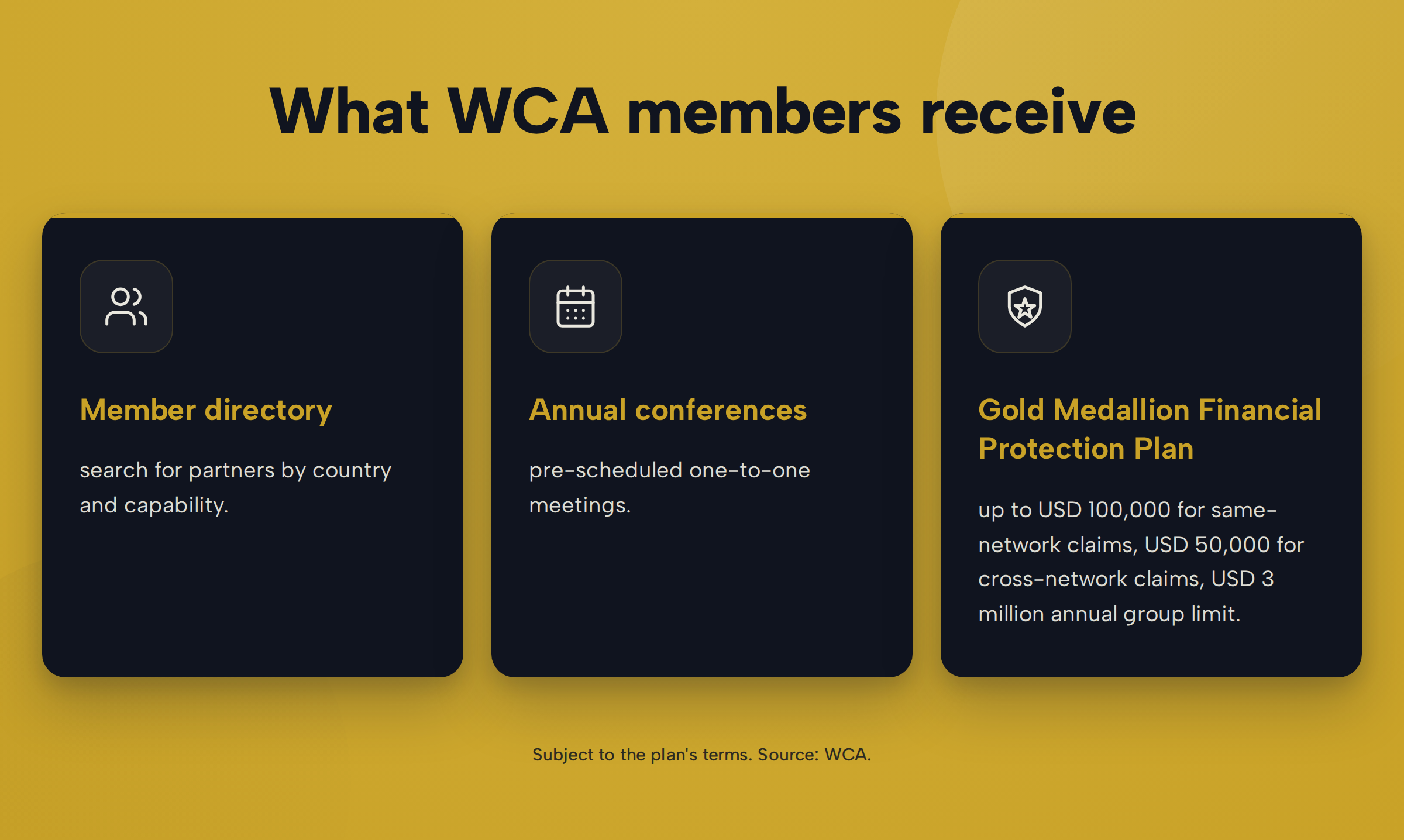
Once approved, members of the WCA freight forwarder network typically gain access to a suite of benefits designed to foster inter-member business. These include:
- Member Directories: A searchable database of all member offices, allowing you to find potential partners in specific countries or with specialist capabilities.
- Annual Conferences: Large-scale networking events where members can hold pre-scheduled one-on-one meetings to build relationships and discuss business.
- Financial Protection: The Gold Medallion Financial Protection Plan is a key benefit. According to WCA's public documents, this plan offers protection for transactions between enrolled member offices, covering up to $100,000 for same-network claims and $50,000 for cross-network claims, subject to the plan's terms and an annual group limit of $3 million (WCA eCommerce Solutions).
It is a commercial network designed to facilitate partnerships. It does not replace your company’s responsibility for local compliance in markets like Nhava Sheva, Jebel Ali, or Felixstowe.
Costs beyond the membership fee
The annual WCA membership fee is only the starting point. A realistic budget must account for the other costs—of both money and time—required to get real value from the network. Before signing, ask yourself these questions.
What will conference attendance cost?
Attending the annual WCA World conference is a major part of the experience for many members. While it offers valuable face-to-face meeting time, it is a significant separate expense. For example, WCA's 2025 Worldwide Conference in Dubai had a delegate fee of $1,450, plus travel, accommodation, and meals (WCAworld). Budget for:
- Delegate registration fees.
- Airfare and visas for your team.
- Hotel and local transport.
- The opportunity cost of having senior staff out of the office for a week.
How much time will your team spend on network activity?
Membership gives you access, but your team does the work. You need to allocate staff time to both send your own RFQs and respond to requests from other members. This includes time for qualifying requests, chasing rates from carriers, preparing quotes, and following up. This is an internal labor cost that can add up quickly, especially across different time zones.

What is the cost of your own due diligence?
A network provides introductions, not a guarantee of quality or solvency. You are still responsible for vetting an overseas agent before you trust them with your customer’s cargo. This includes verifying their licenses, checking financial stability, and confirming their operational capabilities. Membership supplements this process; it does not replace it.
How does the financial protection program work?
The Gold Medallion plan is a powerful benefit, but it has rules and limits. It is crucial to understand what it covers and, more importantly, what it excludes. Protection is tied to "enrolled offices" that are current on their fees. Before extending credit, you must verify that your partner's specific office is covered. The terms are not identical across all networks; see our guide to network protection programmes compared for a detailed breakdown.
Is WCA membership worth it? Test it on your own lanes
The only way to know if a WCA membership is worth the cost is to measure it against your own business needs. Don't be swayed by the total number of members; focus on whether the network can solve your specific lane coverage problems. Your network is your fleet, and it should be run on evidence.
Here is a simple, four-step framework to test the value.
1. Identify your problem lanes
Start by listing the origin-destination pairs where you consistently struggle. These are lanes where you either turn down business or rely on a single, unvetted agent. Be specific: "Nhava Sheva to Felixstowe" or "Los Angeles to Jebel Ali." For each lane, count how many quotes you received in the last year and how much gross profit you lost by not being able to serve them competitively.
2. Measure your current agent performance
For the agents you already use on these lanes, track their performance. How many of your rate requests get a usable reply within 48 hours? A usable reply is one that is complete enough to build a customer quote. A high rate of incomplete or slow replies is a hidden cost draining your pricing team's time.
3. Score your existing partners
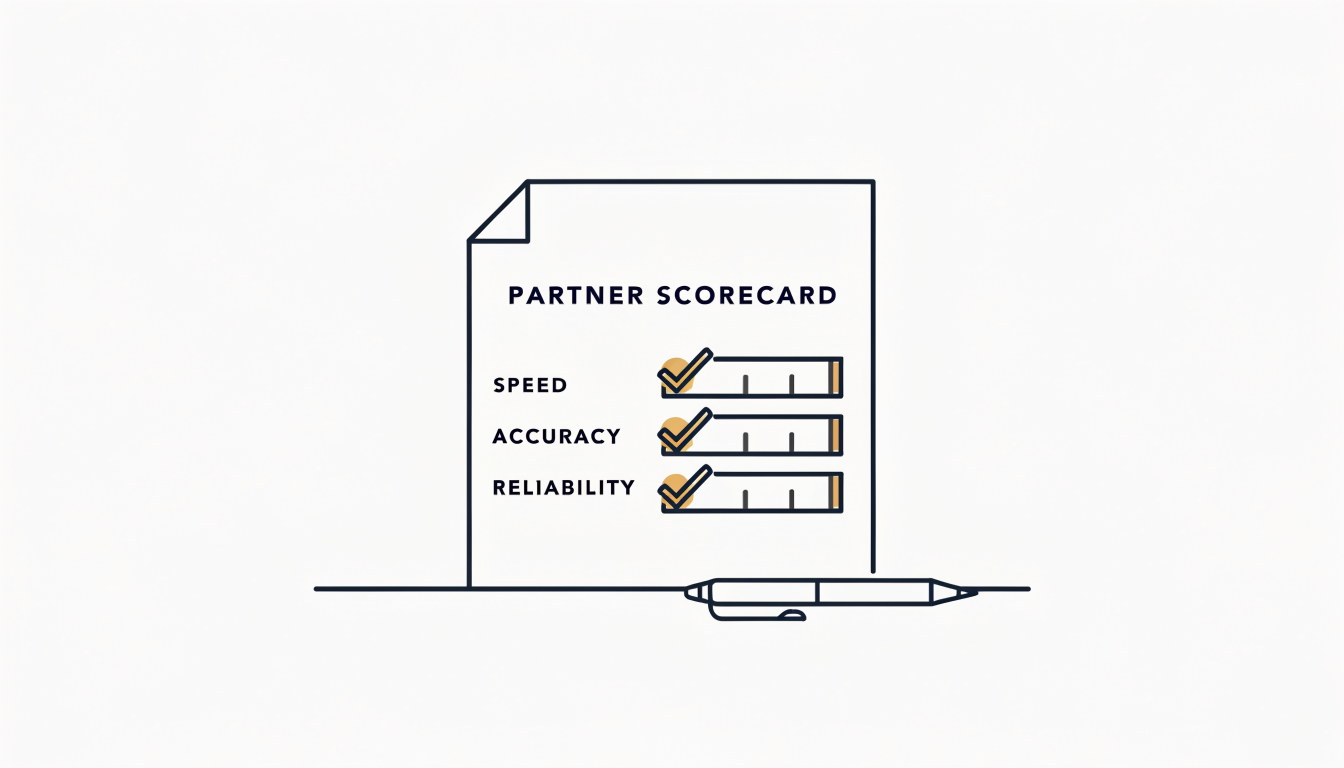
Create a simple scorecard for every overseas agent you work with, based on your own shipment history. Grade them on concrete metrics:
- Quote Speed & Accuracy: How fast do they reply, and how often do their final invoices match the quote?
- Operational Reliability: Do they meet documentation cut-offs and provide timely status updates?
- Exception Handling: How do they respond when something goes wrong?
This creates a performance baseline. A new network partner should have to outperform your existing agents to win the business.
4. Keep a reciprocity ledger
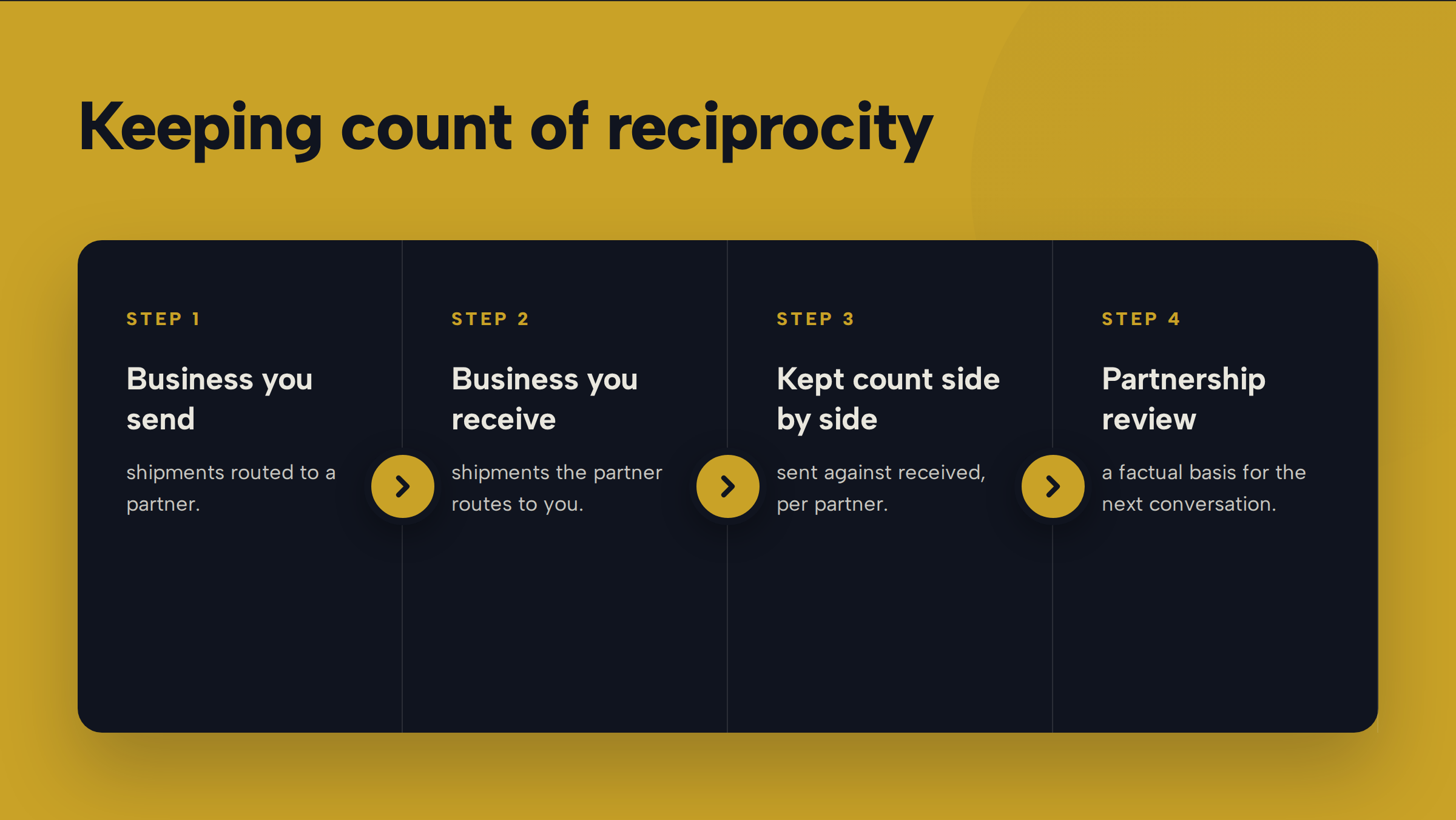
A healthy partnership is a two-way street. Track the business you send to each agent versus the business they send to you. This isn't just about the number of shipments; it's about the value of the business. Use the reciprocity ledger to see which relationships are balanced and which are one-sided. A network should, in theory, improve this balance by connecting you with partners actively looking for agents in your region.
Once you have this data, you can make an informed decision. Weigh the total annual cost of a WCA membership (fee + conferences + time) against the measurable gross profit you could gain by closing the gaps on your problem lanes.
Other ways to find agents
A WCA membership is a powerful tool, but it is not the only way to build a global network. Forwarders have successfully built partnerships for decades using a mix of methods.
Other freight forwarder networks
WCA is one of the best-known networks, and dozens of others exist, some with regional or niche specializations (e.g., project cargo, perishables). The same evaluation process applies: judge them on their ability to provide quality partners on the lanes you actually serve.
Industry conferences
Events run by organizations like FIATA or regional trade bodies are excellent venues for meeting potential partners. The advantage of conference networking compared to a directory is the ability to assess a person face-to-face. However, this approach requires significant investment in travel and time, and follow-up is critical.
Direct relationships
Many of the strongest partnerships are built over time through direct referrals from carriers, customers, or even other forwarders. These relationships are often based on proven trust and performance. The challenge is that they can be slow to build and hard to scale, often relying on the personal connections of one or two people in your organization.
Whichever route you choose, the standard of judgment remains the same: judge partners on their measurable performance, not their promises.
Where VendorFinder AI fits
Whether you are part of the WCA network or building your own, the fundamental challenge is the same: how do you ensure the right lane goes to the right partner, every time? This is where VendorFinder AI, built on FreighAI, works alongside your team.
It is designed to run your network on evidence. It works with or without a network membership by using your own data to make smarter partnering decisions.
Evidence-based partner selection
VendorFinder AI automates the process of scoring agents on performance. It scores your agents and partners from your own shipment history, whether they came from WCA, another network or a direct relationship, so a lane goes to the partner who has actually performed on it. Your pricing team sees who has delivered on the Mundra–Felixstowe lane, not just who has an office there.
Automated reciprocity tracking
Instead of a manual spreadsheet, VendorFinder AI automatically keeps count of the business you send a partner against the business they send you. This gives your network manager a live, factual basis for partnership review meetings, ensuring your most valuable relationships get the attention they deserve.
Streamlined partner discovery and RFQs
For a new lane, Partner Discovery picks the right carriers or agents based on your criteria, prepares and sends a structured RFQ to each, tracks the replies, and lines up the rates side-by-side on one page. This turns hours of manual email and follow-up into a single, managed workflow. Every message a customer sees waits for a person, who can edit, approve or reject it; an approved message goes out in their own name.
The goal is to let your team focus on strategy and relationships, while the system does the homework. To see how it works on one of your own trade lanes, rank a lane live.
Frequently Asked Questions
Does WCA publish its membership fees?
No, WCA does not publish a standard list of its membership fees. The WCA membership cost is provided directly to an applicant during the registration process. Ask WCA how the figure is calculated for your company before you commit.
How do you apply for a WCA membership?
You can apply for a WCA membership through the official WCAworld website. The process involves completing an online application form with your company's details. According to WCA's public materials, applicants undergo a screening process that includes financial and background checks before being approved for membership.
Can I work with WCA members without joining the network?
Yes, you can work with a company that is a WCA member without joining the network yourself. The relationship would be a direct one between your two companies. However, you would not have access to WCA's member directory, conferences, or the Gold Medallion Financial Protection Plan for your transactions with that partner.
Are financial protection programs the same across all freight forwarder networks?
No, they are not. Financial protection programs vary significantly between networks in terms of coverage limits, claim procedures, eligibility requirements, and exclusions. WCA's Gold Medallion plan has specific limits (e.g., up to $100,000 for same-network claims) that may differ from other networks' offerings. It is essential to review the specific terms of any program. For a detailed analysis, see our guide to network protection programmes compared.
What is the difference between a freight forwarder network and a franchise?
A freight forwarder network, like WCA, is an alliance of independent companies that collaborate while retaining their own brands and operations. A franchise, in contrast, typically requires franchisees to operate under a single brand name, use standardized processes, and pay royalties. Network membership is about partnership and access; a franchise is about operating a business under a licensed model.
Sources & References
This article draws on research and data from the following verified sources:
From reading to running.
Everything above runs live in a working partner desk. Bring one lane you don't serve yet and watch the shortlist, the RFQs and the comparison happen.
Book the working sessionKEEP READING